Her imagined landscapes are suggestive rather than specific, evocations rather than pronouncements.
Standing in front of Agnes Pelton’s Sea Change (1931) at the Whitney Museum recently, I heard another viewer looking at the same work say, “Now, that’s weird.” It struck me as an odd remark, because this quiet little painting seemed an unlikely work to provoke such a comment. And yet, on further inspection, there issomething strange about Sea Change. Read the full article →
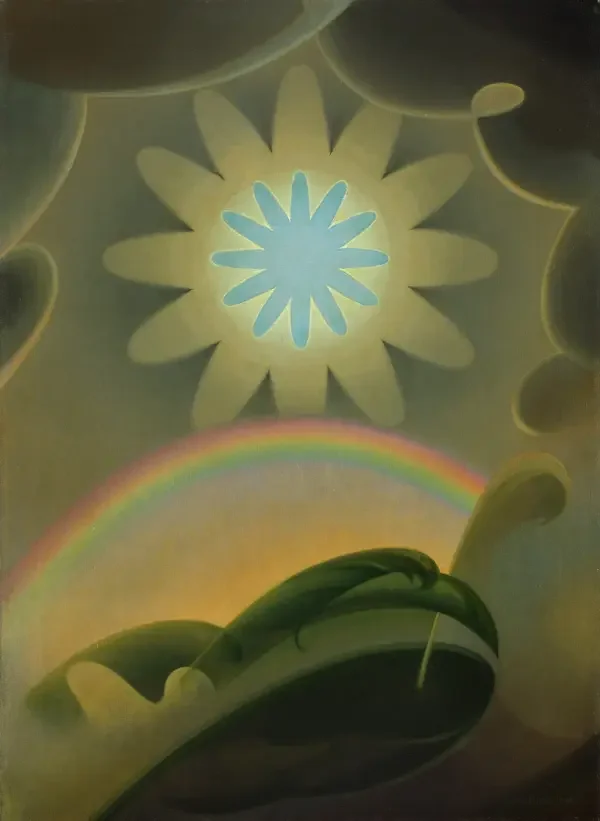
BeinAgnes Pelton, Sand Storm, 1932. Oil on canvas, 30 1/4 x 22 inches. Crystal Bridges Museum of American Art, Bentonville, Arkansas. Photo: Edward C. Robinson III.g by Agnes Pelton, 1926.